Back in 2008, in Cincinnati, a friend named Lindsay saw some ambigram banners I'd drawn that looked like DNA, and suggested I make a sculpture of them. That was all it took. I spent the summer in Google SketchUp, trying to turn those letters into something that could stand.
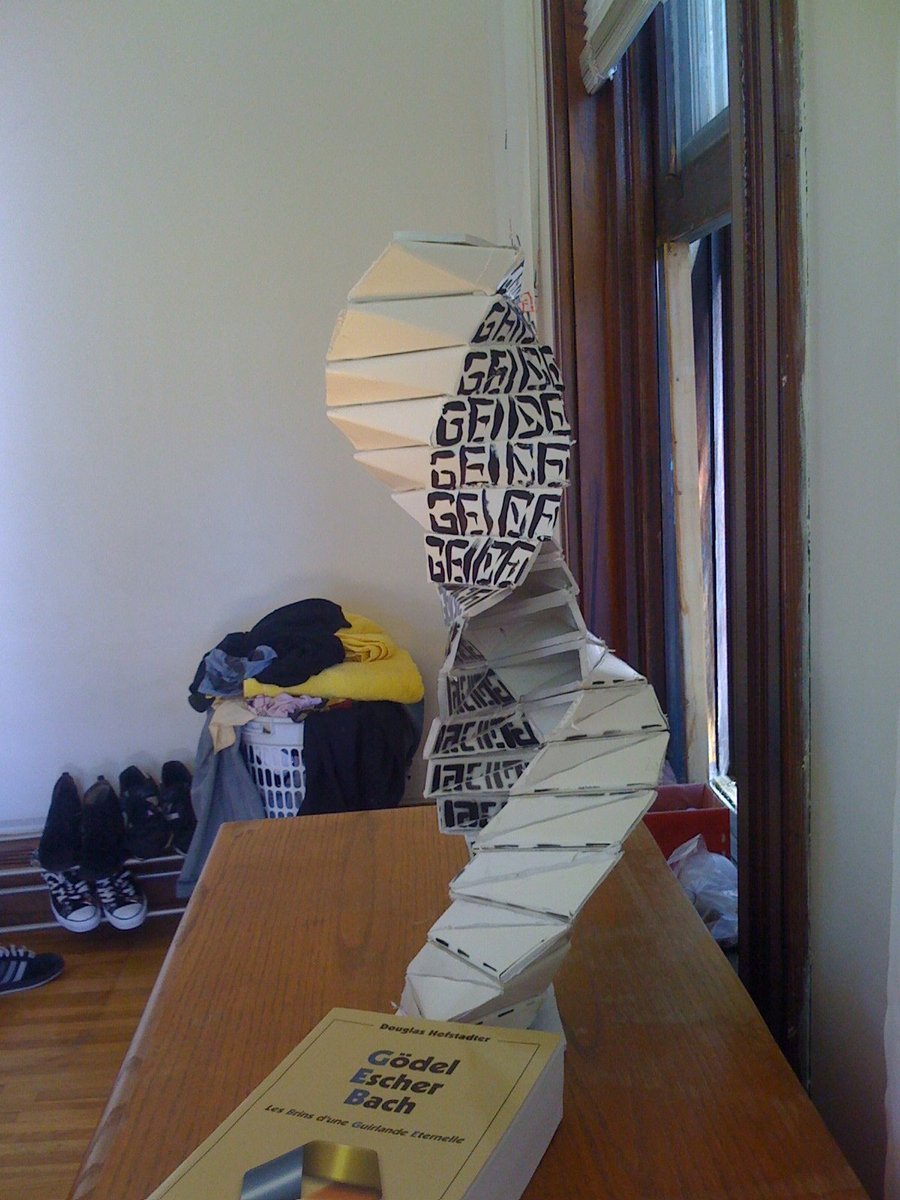
The rungs of the helix carry front-back ambigrams, in the place where DNA would have nucleotides. Look through one side and you read MEME, or BODY. Walk around, and the same cutouts read GENE, or SOUL. The idea is that genes are the building blocks and instructions for bodies, and something similar can be said of memes and souls, in the secular sense: soul as mind, mind as the collection of patterns that make a person. Memes and genes as analogs and opposites, bodies and souls the same way.
It was a Hofstadter project at heart, inspired especially by Gödel, Escher, Bach and Metamagical Themas.
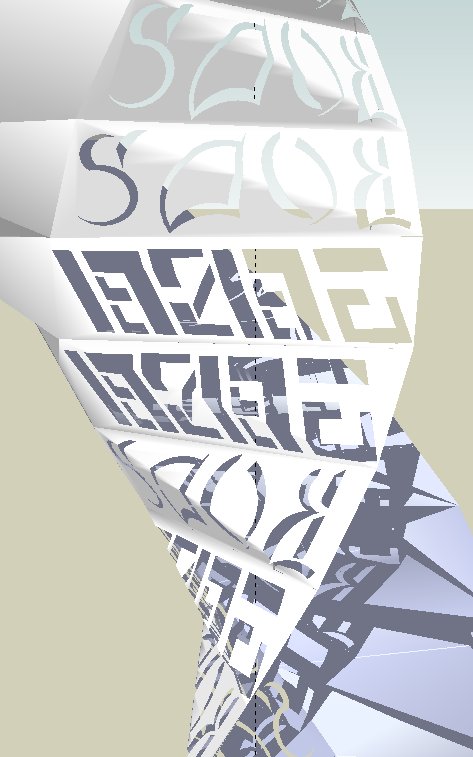
There are 64 rungs, and their sequence encodes a message, the way DNA encodes a protein. I'll save you the puzzle. The plaintext is the Cartesian formula for a helix: x = sin(t), y = cos(t), z = t. The sculpture spells the math that describes it.
The setting is a larger copy of the same helix. A strange loop: a helix sitting inside itself.
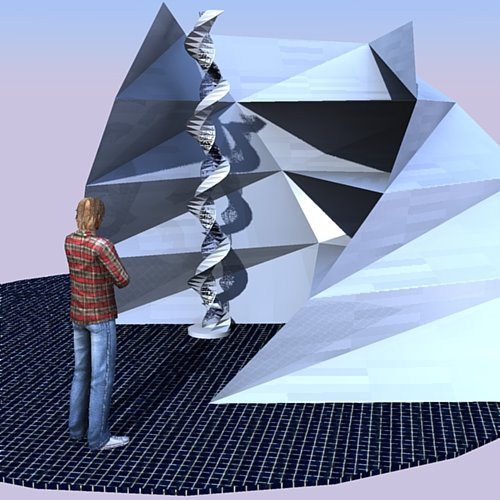
I also wanted light to read the letters. The early idea was to shine a beam through the ambigrams as the piece turned, and later I wrote up a whole apparatus: a laser on a rail, solar-panel faces on the large helix, on-board decoding, even an augmented-reality fountain of swirls over Wi-Fi. Ordinary light through the rungs turned out to be nearly impossible. It would have taken a laser, or something very focused and very bright.
I started the model in late May, after about two days with SketchUp. The first versions looked like turbine blades, and they were fantastically ugly. I'm glad I modeled them before I tried to build them.
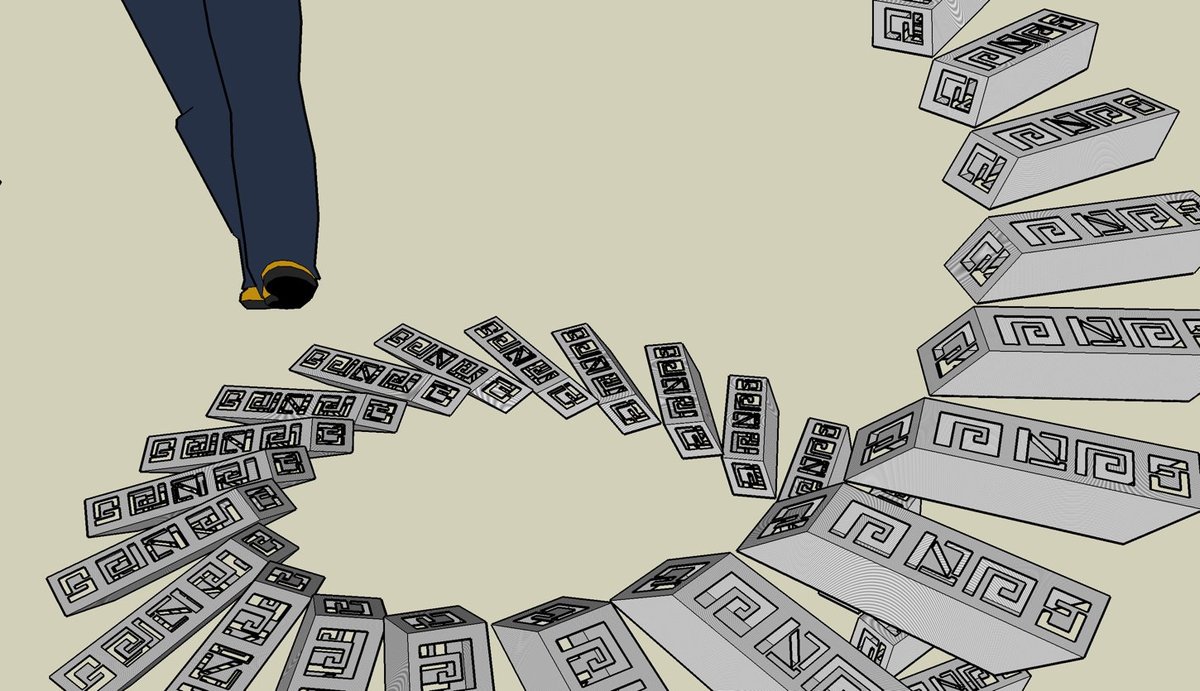
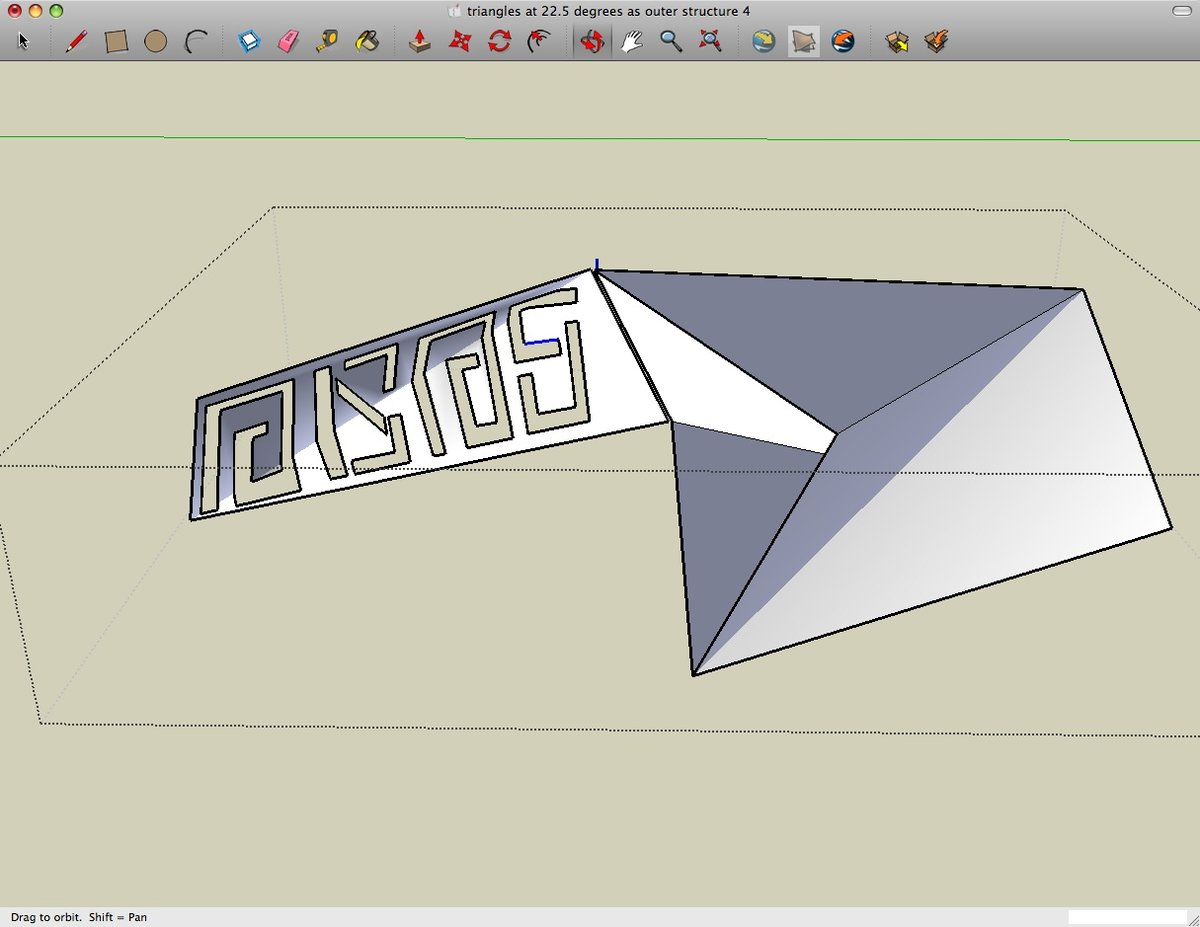
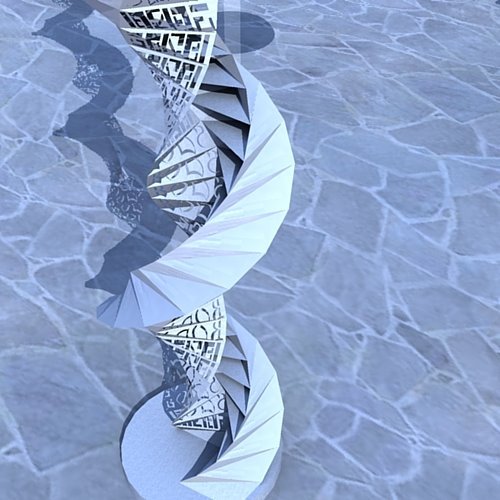
What worked was a foldable sheet-metal module. You take an equilateral triangle, copy it, raise it, and rotate the copy 22.5 degrees — sixteen segments to a turn, four turns in all. Line the bottom of each piece up with the top of the one below it, and a helix forms. I figured each unit could be cut from a sheet, folded, and welded.
In August I built a first physical model: sixteen rungs of cut-and-folded foamcore, with the ambigrams painted on, because the material was too flimsy to cut. I didn't have a proper base, so I propped it on a book to keep the wind from knocking it over. The book was Gödel, Escher, Bach. Unintentional, and pretty much perfect.
Lindsay later encouraged me to finish something showable, so I made a second foamcore piece, just a half turn, with taut diagonal strings to hold the rungs at the right angle. Each string was at a slightly different tension, and it sounded a scale when you ran a finger down it. I don't have a photo of that one.
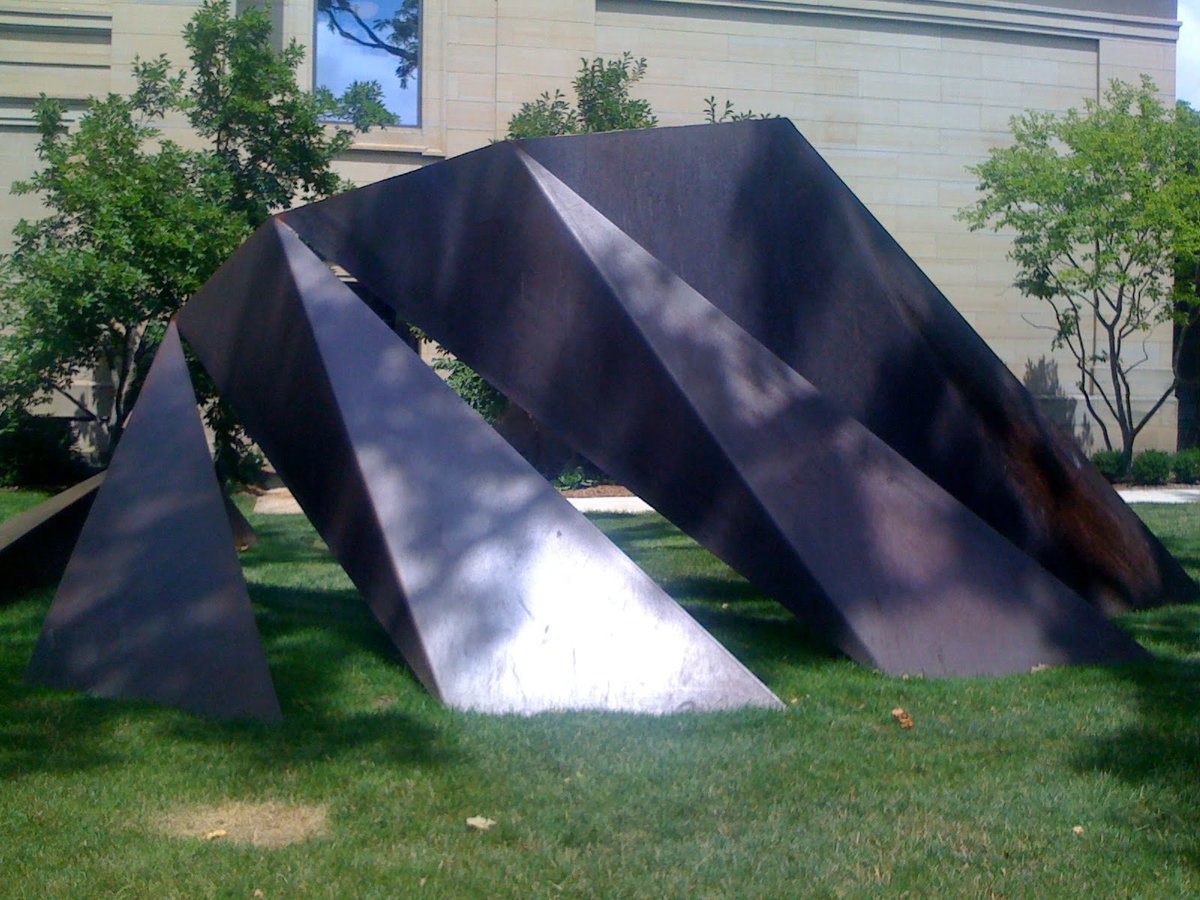
Two years later I was at the University of Michigan Law Quad and photographed Chuck Ginnever's 1972 Daedalus. The parallelogram helix geometry is uncannily close to the modules I'd been folding in SketchUp. I stood there wondering whether we'd arrived at the same angles for the same reasons, or whether I'd just wandered into a coincidence.
The SketchUp model has been sitting in 3D Warehouse since that October. I'm bringing it into the 3D gallery on tjm.art, so you can walk around it while it turns.
-TJ
Studio notes by email
New paintings go to subscribers first, a few times a year. One print at cost when you join. Unsubscribe anytime.